When businesses want to grow online, two strategies often come up: SEO and Paid Advertising.
Both can bring visitors, leads, and customers—but they work differently, require different investments, and produce results on different timelines.
🔎 SEO — Building Long-Term Visibility
Search Engine Optimization (SEO) is the process of improving your website and online presence so that it can appear higher in organic search results.
Instead of paying for every click, you invest in improving your website’s content, technical performance, authority, and relevance.
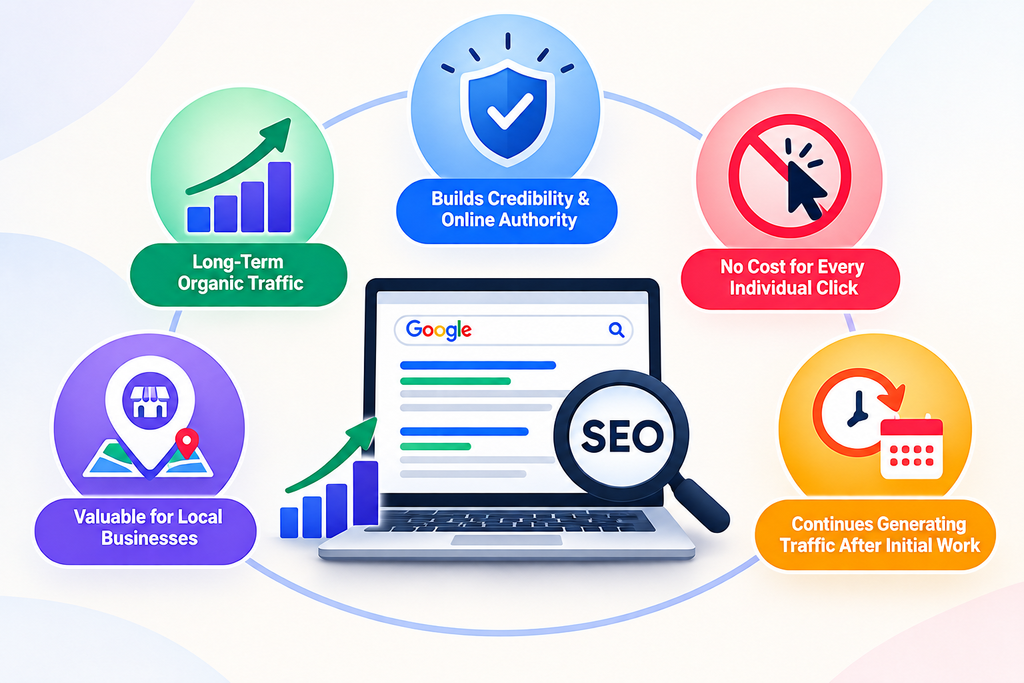
Pros of SEO:
Can provide long-term organic traffic.
Builds credibility and online authority.
No cost for every individual click.
Can continue generating traffic after the initial work.
Particularly valuable for local businesses targeting location-based searches.
Cons of SEO:
Results usually take time.
Requires consistent optimization and quality content.
Competition can be high for valuable keywords.
Rankings are not guaranteed.
Search engine algorithms and user behavior continue to evolve.
💰 Paid Ads — Paying for Immediate Visibility
Paid advertising allows businesses to pay platforms such as Google or social media networks to display their advertisements to selected audiences.
Unlike SEO, you don’t have to wait months to start getting visibility. Once a campaign is properly set up and approved, your ads can start reaching potential customers.
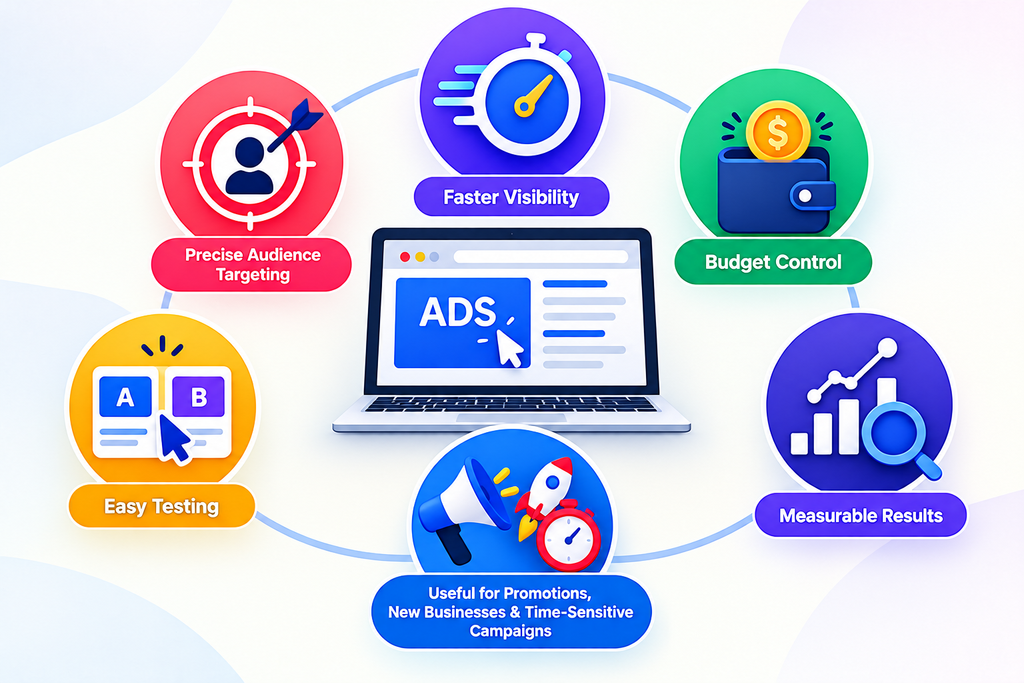
Pros of Paid Ads:
Faster visibility.
Precise audience targeting.
Budget can be controlled.
Easy to test different offers and audiences.
Useful for promotions, new businesses, products, and time-sensitive campaigns.
Results can be measured through clicks, conversions, and other campaign data.
Cons of Paid Ads:
Requires an ongoing advertising budget.
Costs can increase in competitive markets.
Traffic generally decreases when advertising stops.
Poor targeting or weak landing pages can waste budget.
Getting clicks doesn’t automatically mean getting customers.
⏳ SEO or Paid Ads: Which Is Faster?
Paid Ads generally win for speed.
If you need visibility for a new product, promotion, or service, advertising can put your business in front of potential customers much faster.
SEO is a long-term strategy.
It takes time to establish rankings and authority, but successful SEO can create a sustainable source of organic traffic.
📊 Which Is More Cost-Effective?
There isn’t one universal answer.
Paid advertising requires a continuous advertising budget, while SEO requires investment in strategy, content, technical improvements, and ongoing optimization.
For a business with a limited budget, SEO can be attractive for building long-term visibility. For a business that needs immediate traffic or leads, paid advertising can be more practical.
The right choice depends on your industry, competition, goals, budget, and customer journey.
📈 What About Current Digital Marketing Trends?
Search behavior is changing.
People are increasingly using search engines, maps, social platforms, reviews, and AI-powered search experiences to discover businesses and products.
This makes it even more important for businesses to build a strong overall digital presence rather than depending on just one channel.
SEO is also becoming broader than simply ranking for keywords. Helpful content, user experience, technical performance, local visibility, brand credibility, and quality information all matter.
At the same time, paid advertising is becoming more sophisticated, with platforms increasingly using automation and machine learning to optimize targeting and campaign delivery.
So, Which One Should Your Business Choose?
The real question isn’t always SEO vs. Paid Ads.
For many businesses, the strongest approach is SEO + Paid Ads.
🚀 Paid Ads can help you generate immediate visibility and test what attracts customers.
🌱 SEO can help you build sustainable organic visibility over the long term.
Together, they can create a more balanced digital marketing strategy:
Paid Ads → Immediate Reach
SEO → Long-Term Visibility
Both → A Stronger Online Presence
💡 The Bottom Line
There is no magic marketing channel that works equally well for every business.
The best strategy is the one that matches your goals, budget, audience, competition, and timeline.
If you’re only focusing on paid ads, you may be missing an opportunity to build organic visibility.
If you’re relying only on SEO when you need immediate results, you may be waiting longer than necessary.
Smart digital marketing isn’t about choosing the trendiest strategy—it’s about choosing the right strategy for your business.